Gallery of past work

Saturday, 8 December 2012

Muchelney Pottery and floods on the Somerset Levels

Two days ago, I visited the Somerset Levels with a friend. We were trying to find our way to the Muchelney pottery in search of pots by John Leach, the latest member of the Leach potting dynasty.

This is a beautiful area, but troubled just now by flooding. We were amazed that the village of Muchelney itself remained cut off when we visited two weeks or more after the flooding and residents were still having to go in and out of the village by boat or by tractor.

It was a wonderful afternoon as we drove down, cold, calm and sunny. In the lowest-lying areas, field after field was flooded. Being near sunset, there were glorious colours in sky and water. I had my camera with me and took several photos. My friend, who knows how I often work, suggested the scene could make a lovely silk landscape piece. I think she may be right.

Despite the recent floods, the pottery, just outside the village itself, was accessible - just, and only from the South. The property had suffered flooding for the first time in living memory. The house was inundated, together with studios and wood store, but the shop somehow was not and was open and very happy to receive visitors.

The wood-fired stoneware pots are both useful and beautifully crafted. I have several pieces I've bought on previous visits and bought some more this time for Christmas presents.

The shapes are strong and satisfying and feel good and balanced in the hand. I love the rich brown figuring on the unglazed outside faces, caused by the flames lapping around the wares in the firing.

John Leach is shown throwing as on his website at: http://www.johnleachpottery.co.uk/ - well worth a visit if you like beautifully made - and useful - stoneware.

Sunday, 2 December 2012

Textile Christmas Cards with Transfer Dyes


I just couldn't make the snow landscape idea for Christmas cards work satisfactorily. The design was disappointing and each card was taking too long to make. I have to get going on a rapid production line or it takes me months to make my cards.

Four of the cards in their mounts
and with a greeting
I've reverted to Plan B - always a good idea to have one of those....

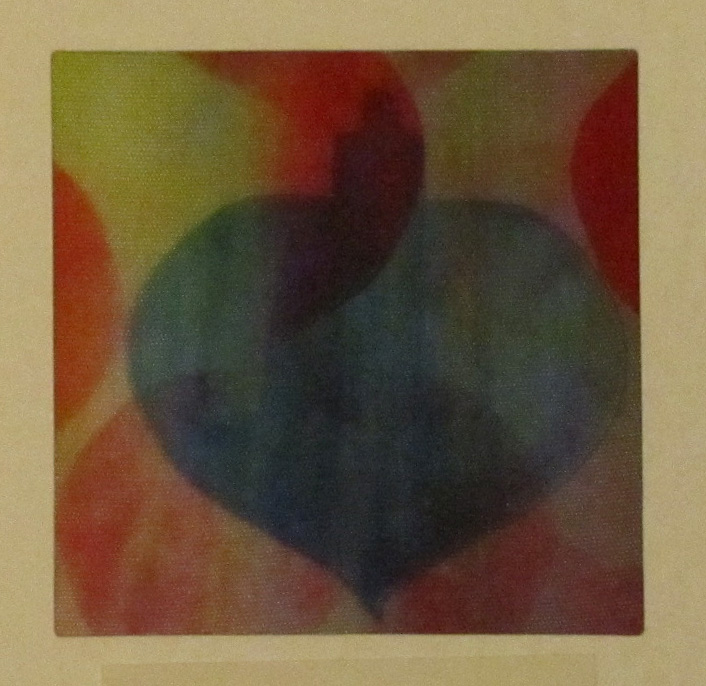
Plan B is a design of random coloured bauble shapes in bright colours. The shapes were heat set onto polyester lining fabric in a fairly haphazard fashion using transfer dyes.

I cut out suitable shapes, both positive and negative from computer paper, and used them to mask areas as I coloured  the fabric, overlaying the colours and shapes.

Transfer dyes and masking shapes
on polyester lining fabric
I used powdered transfer dyes from Art Van Go which I mixed up ready in the little bottles shown and then painted pretty well neat onto A4 computer paper. The colours mix themselves as they are applied to the fabric so I didn't mix before painting.

To heat set the design onto the lining fabric I used an old domestic travel iron which gave the varied intensity of colour I wanted for these cards. With practice, you can judge how long to heat the fabric to get the effect you want. It's very important to use an old iron, not your prize new steam iron, as the sole plate can become stained by the transfer dyes.

The resulting cards are colourful, each one is unique and I'm quite pleased with them.


Now I just have to mount them into the card stock, add a greeting and my labels and the job will be done.


Tuesday, 27 November 2012

Wiltshire Floods - Cricklade North Meadow

This afternoon, I drove to Cricklade North Meadow in Wiltshire - a favourite place for me in recent times to see wildlife and landscape. Since discovering this lovely place when our textile group took the meadow as a focus for work, I've visited many times, especially in spring for the fritillaries, in autumn and once in winter when the meadow was under a foot of snow. It's always a delight.

This time following the recent torrential rain, the flooding was spectacular.  The River Thames had burst its banks covering the fields in the flood plain and threatening farms and low-lying houses.

I took lots of photos in the late afternoon light. The colour palette was subtle and almost monochrome.

I love this one, with its contrasting areas of reflection and wind-ruffled surface and the willow trees silhouetted against the light sky, 


and especially this one with the stripe of thousands of brown dock seed heads in the distance and bare branches and rose hips in the foreground. 

This reserve is a Special Area of Conservation, administered by Natural England.  It's one of the finest examples of a lowland hay meadow in Europe - there used to be so many more. These sites are now so precious.

The meadow supports Britain's largest population of snake's head fritillary. Fortunately, this lovely flower thrives in meadows with winter flooding. Around half a million of the dark pink flowers can be found here each year in April and I am sure that next spring will be all the better for this flood. I can't wait....

Details of Cricklade North Meadow can be found at http://www.naturalengland.org.uk/ourwork/conservation/designations/nnr/1006112.aspx.


Sunday, 25 November 2012

COLOUR INSPIRATION 

I draw on all sorts of things when I'm planning textile work but one of the main things is colour. For me, it often works in an oblique way. My eye may be taken by a colour combination in a garden, in the landscape around my home or perhaps in the wild places I visit in Scotland. Then later I use this colour image in a piece whose subject matter has nothing to do with the landscape where I first saw it - but may be that's how it works for everyone.

Silver Birch and heather in Glen Quoich, Aberdeenshire
Recently, I've been collecting together photos to use in work on the geology and rocks of the Cotswolds.

I love the acid yellow and brown in this photo taken in the Highlands of Scotland. I haven't manipulated the colour in Photoshop - this is just as I saw it.

And the rich brick red, browns and ochre yellows in this wall.


And the purple, yellow and green in this photo taken in a garden - though perhaps I use this combination too much. 


The last two were taken last summer in the walled Garden at Lydiard House, near Swindon in Wiltshire. The colours were wonderful and the weather was warm and sunny and very good for photography and I have a very clear image of the colours in my mind. 

I know there is no relationship between the subject matter in these photos and my geology pieces but their colours crept into my memory and I know I will use them as I finally make my colour choices - I can feel it coming ...... 

Wednesday, 21 November 2012

Making Textile Christmas Cards


I've been making my own Christmas cards for several years now and people seem to enjoy receiving them. An example of last year's is shown left.

It was made using transfer dyes on polycotton. I ironed on background colours lightly and masked out snow flake shapes when I added the final colour. Then I over-printed the shapes again. On some - I get bored doing the same thing 100 times - I added some stitch but they weren't so successful, I don't think. This was one time stitch seemed unnecessary.

Not sure what to do this year. That's the problem - thinking up a new idea each year .... As you can see in the photo of my workroom (in creative? chaos), I've been playing around with discharging star shapes into blue Quink ink on silk dupion or cotton (cheaper but not so nice) and then using an Art Van Go printing stamp onto which I brushed thickened bleach with a bit of old car sponge. Hope my husband doesn't notice its disappearance!


I'm always tempted to turn everything into a landscape so I've added a strip of white sari silk to represent snow. I've then over-printed with Lumiere Halo Gold  paints and a star-shaped Indian wood block. I quite like the effect - just not sure if it's all that Christmasy.

Will try out the idea on my resident critic when I've added some stitch. I'm sure there will be new developments as I go along. He'll certainly have comments to make! Just hope they're positive as I seem to be rather lacking in new - and practical - ideas this year.

Saturday, 10 November 2012

Framing and presenting work


Margaret Thatcher
Weaving in a box-type frame
I'm organising a 'show and share' session next week for our WCE group, Great Western Embroiderers, about framing and presenting work  - cheaply. That, of course, is the catch. We all know of framers who will charge over £100 to stretch and frame an A4 sized piece of work (and they do a good job) but for our group that is just not worth while if they are to offer work for sale at a sensible price.

Trips to Hobycraft or IKEA are much more likely to yield realistic results so I'm searching out suitable examples and hoping to glean some more ideas from the group.

I'm going to show them how I do my shallow box-type frames for my woven pieces as my contribution. These are  improvised from a suitably sized mount, spaced from the work and reinforced by strips of foam core board which also edge the box part of the frame. I then attach the work to more foam core board covered with a light muslin and put the whole thing into a deepish Hobycraft frame. It is then backed all over with hard-board to give more depth for the work - quite easy to do and not requiring many carpentry skills but seeming to look quite convincing - and really cheap.

Sea Sampler - in a commercial frame
I'll also show them a photo of my Sea Sampler - commercially framed and behind glass as a gift for a friend - so we can discuss choice of the frame colour to harmonise with the work.

I know also that it will provoke much debate about using glass. Buyers so often seem to prefer things behind glass but I don't normally do that for my own work and won't be for our upcoming exhibition - I almost never do, in fact. To me, glass seems to put a physical barrier between work and the viewer. There is almost always too much reflection and it stops people being able to see the details easily. I like people to be able to touch my work, and to experience the tactile character of the textile.

I know that there is concern about work getting dusty but I don't really find that a problem. A gentle blow and shake seems to be all that is needed. A friend recently gave me what sounds like a great tip for cleaning unglazed textiles when they've been on the wall a while. She gets out her hoover, covers the metal end of the wand with a pop sock, tightly attached with a rubber band, turns on the hoover and moves the end gently over the textile, about 1 cm from the surface. Dust is removed and textile undamaged. She assures me it does work. Do I dare to try?